
Identify Who Owns a Luce County Parcel
Ownership work starts at the county-linked parcel gateway. It ends at the recorded instrument. Luce County publishes no universal owner-search form, so keep the parcel number and legal description at the center of the search.
- Locate the address in the Colligo Luce County project, or ask the assessor to identify the parcel.
- Copy the owner-of-record label, parcel number, situs, mailing address, legal description, and tax year exactly.
- Ask the Register of Deeds to search the latest grantee and grantor entries for that parcel and description.
- If the deed names a company, use Michigan's official business registry to identify the entity record, without assuming its agent owns the land personally.
- Compare the newest deed date with the assessment year before stating who owns the property.
Two records answer the question of who owns this property. The roll shows Luce County's current administrative label, while the deed shows the recorded transfer.
Where Luce County Property Owner Names Appear
No single Luce County source answers every ownership question. The map and the tax roll point to a candidate owner, the Register of Deeds supplies the recorded transfer, and tax and entity records add context.
| Source | Owner Info It Gives | Access |
|---|---|---|
| Assessment roll | Owner label, mailing and situs fields, parcel, value year | Local assessor or Equalization request |
| Register of Deeds | Latest deed parties, legal description, book/page or instrument reference | Office search, copy, or vault appointment |
| MiBusiness Registry | Michigan entity filings and registered-agent context | Official state registry |
| Colligo parcel map | Mapped parcel and any card fields actually enabled | Free county-linked gateway |
| Treasurer | Tax history tied to parcel and owner labels | Office request; no bill-search URL confirmed |
An owner of record can live far from the parcel. Holding land through a company is common too. The roll year may also lag behind a transfer that has already closed. Neither a tax mailing address nor a map label proves occupancy, since the person on the land may be a relative, a guest, a purchaser awaiting an update, or another lawful possessor.
Read the Luce Owner-of-Record Field Carefully
The Luce County Equalization office supports the assessment system. It links parcel resources on its public page, though the live card's owner-field spelling and refresh schedule follow the office's own posting cycle. Report the label exactly as displayed. Attach the assessment year, and avoid turning a tax-roll label into a quiet legal conclusion.
Four ownership terms
Owner of record is the party on the current roll. Grantee is the recipient named in a deed. Situs locates the land, while the mailing address receives official correspondence and may sit outside Luce County.
When the map returns no card, ask the local assessor for the same fields. Note whether the answer reflects the current roll or the prior one.
Trace the Luce County Property Owner to a Deed
The Luce County Register of Deeds is the confirmation step. Its public page lists deed, mortgage, land-contract, discharge, covenant, plat, and lis-pendens services. It also notes related recordings. It posts no public online index. No earliest digital year is published either. Real-estate searches cost $0.50 per name per year. A $5 minimum applies. Plain copies run $1 per page, and certification adds $5 per document. When you request a search, give name variants and an approximate transfer range. Also give the township or village, the legal description, and the parcel number. Ask for the newest deed that matches the legal description. Compare its grantee against the assessment label. Remember that a deed can also show how title is vested. It can also show whether multiple grantees are named.
Note: Ask whether a no-result response means no index hit. Ask whether it means no image, or no deed under the submitted spelling and years.
Follow Luce Ownership Held by a Trust, Estate, or Company
A parcel can name a trust, an estate, a limited liability company, or another entity instead of a person. Search the name exactly as the roll and deed spell it. For a Michigan company, the MiBusiness Registry can provide current state filing context. The registry launched in June 2025.
A registered agent is a contact for the entity, not automatic proof of personal ownership or beneficial interest. Trust beneficiaries may never appear on the tax roll. Estate ownership can require a Probate Court file, a death record, a court order, and a later fiduciary deed before the assessment label changes. Describe only what each public record names.
Resolve Newberry Owner Questions Across Local Lines
Newberry is Luce County's only incorporated community. It sits within McMillan Township. A property may carry a Newberry postal address. Its assessment, tax, or map context may instead point to the township. ZIP 49868 likewise reflects postal delivery, not a surveyed municipal boundary.
Resolve the mismatch with the parcel and legal description. Village zoning records can describe local approvals. County land records still run through the Register of Deeds. For the present roll label and its update timing, continue to the Luce County current owner guide.
Respect Protected Addresses in Luce County Records
Michigan's Address Confidentiality Program gives eligible survivors a substitute address and mail forwarding. Public property and voter systems should not be used to defeat that protection. A record may expose a protected address. Contact the source custodian and the program. Do not republish it.
The Michigan FOIA reaches identifiable records held by covered public bodies. Exemptions and other laws still apply. A broad request for all records about a person is less accurate than a parcel-specific request. It is also more intrusive. Limit the inquiry to the land, dates, and record type needed.
Use Luce Tax and Transfer Clues Without Overclaiming
The Luce County Treasurer keeps permanent tax rolls and delinquent rolls. The office also holds tax histories, redemption details, and current-tax certifications. Those property records show whether a parcel number and its owner label hold steady across a stated tax period. Payments, though, never prove title. The county publishes no online tax-bill search. The reliable route is a request to the Treasurer at 906-293-8171.
Michigan Form 2766 feeds transfer date, price, parcel, buyer, seller, and classification into the assessment process. Form 2368 files a Principal Residence Exemption claim along with the assessor's outcome. Both are strong cross-checks for a Luce County property search. Still, a PRE status is not proof of current residence. A named person may not live at the parcel right now.
The county's official Equalization page displays its assessment and parcel resources in one place.
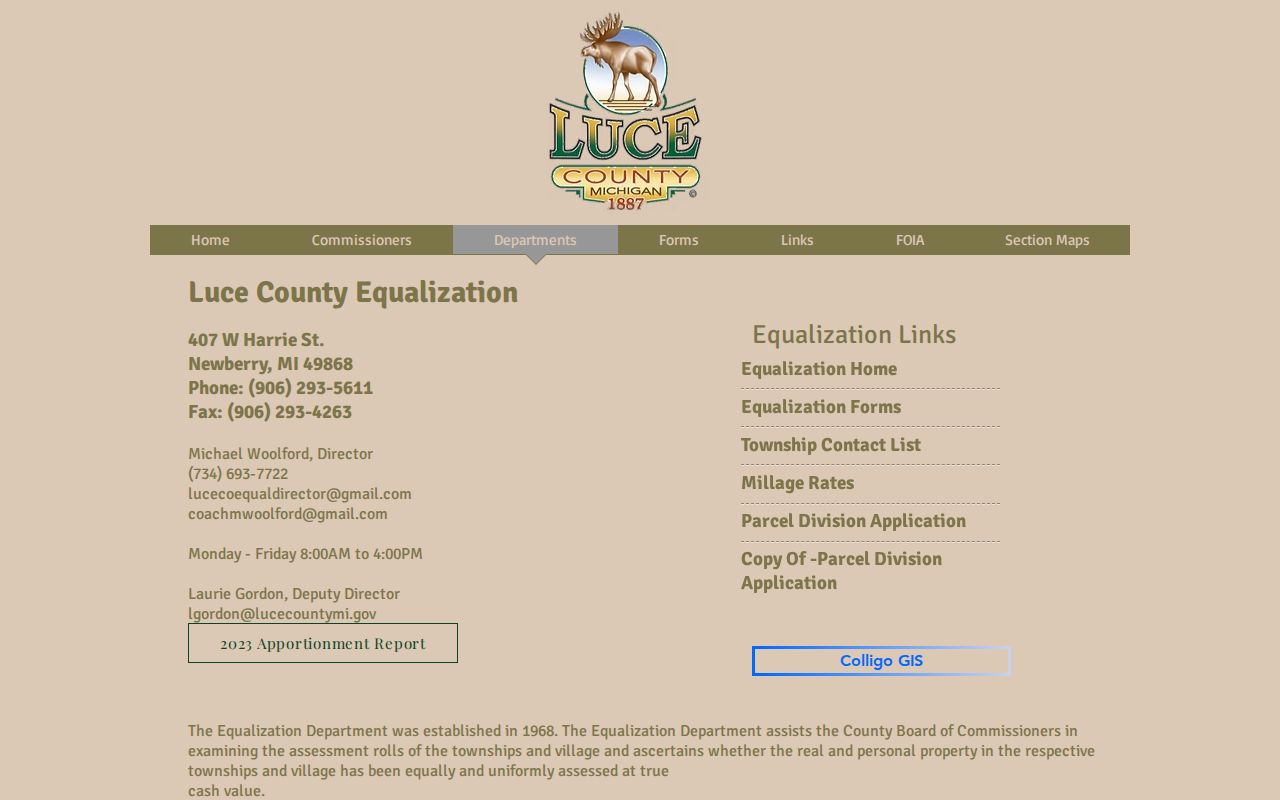
That official page shows where Luce County routes assessment questions. Confirming the current owner of record still takes the latest recorded deed.
Know What a Luce County Ownership Lookup Cannot Prove
A parcel card, a tax roll entry, a GIS map label, a deed-index hit, and a court result each answer a different question. None of them alone proves occupancy, beneficial ownership, a surveyed boundary, or clear title. Timing matters too. A freshly recorded deed can outrun the annual assessment roll, so the deed records may name an owner the roll has not caught up with yet.
Lawful use. Use owner records for property due diligence, boundary questions, estate work, and civic transparency. Michigan law prohibits stalking and harassment; never use an address to target or repeatedly contact anyone.
Before a purchase or a legal dispute, get certified instruments and qualified title or legal help. State any finding narrowly: "the roll lists," "the deed names," or "the office reports." Precision here prevents most ownership mistakes.
Test the legal description through recorded plats and section context. Luce County includes rural township-and-range land as well as village lots. A street address is convenient. A lot and block, site-condominium unit, or township-range-section description is what lets a clerk tell two nearby tracts apart. Michigan Online Land Survey Records can locate survey or plat material by record type, number, project, and date. The Register of Deeds supplies the recorded plat or a certified copy. Luce County lists plat copies at $2.
Court, lien, and probate records are separate checks. MiCOURT may surface a public quiet-title, foreclosure, partition, or estate matter. Its search is informational, and some files still require the clerk. A lis pendens signals litigation tied to land. It does not settle ownership by itself. A mortgage or tax lien likewise never replaces the deed's grantee. Follow each clue back to the office that holds the underlying instrument or order.
A sound owner finding names the parcel, the source, the date, and the limitation. Save the map view, the assessment year, the deed reference, the legal description, and the office response. When Luce County property records disagree, keep both versions and ask the assessor or deed clerk what changed. This record-centered approach is slower than copying a single online name. It is also far less likely to attach an owner to the wrong parcel.
For every conclusion, separate an indexed name from a certified instrument, and a dated roll from a live claim of ownership.