
Luce County Deed Types
Deeds, mortgages, and more all live with the Register of Deeds. That office keeps Luce County deed records in the County Government Building at 407 West Harrie Street in Newberry. A deed names the parties. It states the land description. It also proves an instrument was accepted for recording. The office holds mortgages, land contracts, assignments, discharges, covenants, lis pendens notices, easement-type instruments, lien copies, and recorded plats. Those papers can affect land without transferring full ownership. Instrument type is the first clue, not the last word.
| Deed Type | What It Does | Common Use |
|---|---|---|
| Warranty deed | Transfers title with stated promises from the grantor. | An ordinary sale or other full conveyance. |
| Quitclaim deed | Transfers only the interest the grantor may hold. | Family transfers or correction of a title issue. |
| Trustee or fiduciary deed | Conveys land through a trust or authorized fiduciary. | Trust and estate administration. |
| Land contract | Records terms for an installment land purchase. | Seller-financed ownership arrangements. |
| Tax deed | Documents a transfer tied to tax foreclosure. | Formerly delinquent property. |
A mortgage or lien is an encumbrance, meaning a claim or burden tied to land. It is not a deed. Read the later assignments, releases, and discharges alongside the transfer instrument itself. A clean file keeps every recorded reference, party name, date, and legal description together.
Luce County Deed Search Starts Offline
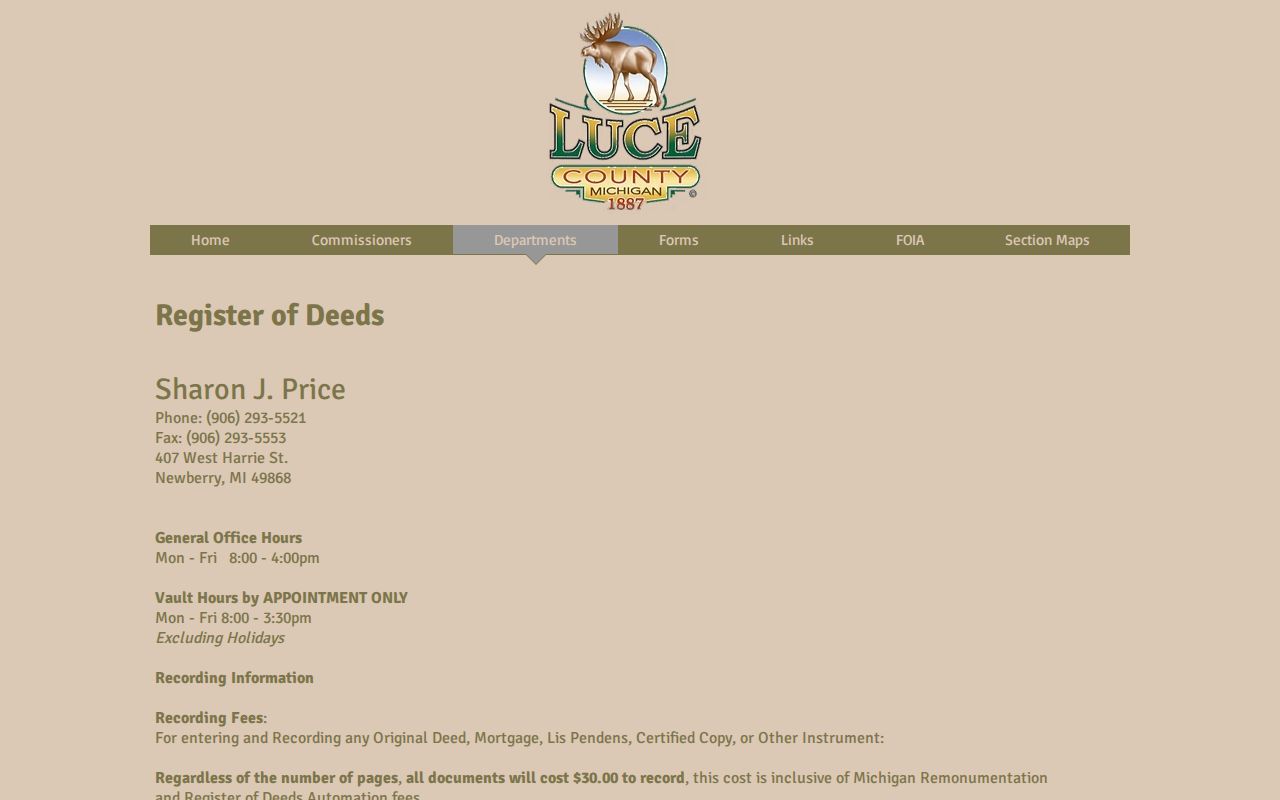
The official Register of Deeds page publishes detailed rules and prices, but no public online deed-index form or imaging start year. That gap matters. An empty web search does not mean no deed exists. Call the office at 906-293-5521 or arrange a vault appointment on a weekday. The vault schedule runs 8:00 a.m. to 3:30 p.m., while the general office stays open until 4:00 p.m.
Give the clerk a tight request. Include grantor and grantee spelling variants, an estimated year span, township or local unit, parcel number if known, and the full legal description. Ask how the office index searches, since parcel number, address, book and page, instrument number, and party name fields are not published. For rural land, township, range, section, and adjoining-owner language may work better than a mailing city.
Luce County Deed Search Fees
The county price list makes budgeting concrete. A real-estate search costs $0.50 per name per year, with a $5 minimum. A fixture-filing search runs $6 per name. Plain deed copies are $1 per page. Plat copies cost $2, and certification adds $5 per document. Recording an original deed, mortgage, lis pendens, certified copy, or other instrument is a flat $30. That fee holds regardless of page count. Extra assignments or discharges beyond one instrument add $3 each. The county fee and recording page is the place to check before ordering.
Scope the request before paying. One name for one year still reaches the $5 minimum. A twelve-page plain copy costs $12, and certification adds $5 more. These examples follow the published schedule. But they are not a quote for a complex index project. Ask whether separate spellings or date blocks create separate minimum searches. The official online resource serves as an office guide. It is not a public grantor-grantee search screen.
Note: A certified copy carries the custodian's certification; a plain copy reproduces the pages without that official attestation.
Build a Luce County Deed Chain
A grantor transfers an interest, and a grantee receives it. A chain of title is simply the ordered sequence of those transfers. Luce County does not publish its exact index controls. Yet the standard backward method still works at the counter. Keep the legal description fixed while the names change. Book and page identify a volume location. An instrument number is a unique recording reference. Record whichever system the clerk returns.
- Use the parcel card or latest known deed to name the current grantee.
- Read that deed for its grantor, recording reference, date, and legal description.
- Search the grantor as an earlier grantee, testing initials and alternate spellings.
- Repeat while the land description stays consistent, then move to physical books or archives when the index path stops.
- Grantor
- The party transferring an interest in the property.
- Grantee
- The party receiving the stated interest.
- Chain of title
- The linked run of recorded transfers for the same land.
- Book/page and instrument number
- Two ways an office may cite a recorded document.
Record Luce County Deeds Correctly
Luce County requires original signatures, printed or typed names under signatures, and matching notary information. A grantee street number or post-office address must appear, along with the drafter's name and address. Use black ink of at least ten-point type on white paper. The first page needs a 2.5-inch top margin, later pages need one-half inch, and acceptable sheets range from 8.5 by 11 to 8.5 by 14 inches.
A warranty deed, land contract, assignment, covenant deed, or deed covenant needs a tax certificate before recording under MCL 211.135. That certificate costs $5 for up to 25 descriptions, then $0.20 for each added description. County transfer tax is $0.55 per $500 or fraction under MCL 207.505, while state transfer tax is $3.75 per $500 or fraction under MCL 207.526. The consideration appears on the deed unless a valuation affidavit is used. A document naming a survivor also needs proof of death.
Plats Clarify Luce County Deeds
Addresses change. Legal descriptions stick to the land itself. A lot-and-block description points back to a named plat. Rural deeds work differently. They may run metes and bounds, courses and distances from a fixed point, or government-survey calls by township, range, and section. The Archives guide places Luce County in ranges 8W through 12W and townships 45N through 50N. Ask the Register of Deeds for that plat. Michigan's Online Land Survey Records can also be searched by record type, number, project, or date, and the attachments often tie a subdivision or survey project to a deed. A plat is not a field survey. It depicts recorded geometry rather than current monument locations, so compare it against the deed and the parcel map before trusting any boundary conclusion.
When Luce County Deeds Leave the Web
Luce County was organized in 1887. Its parent counties are Chippewa and Mackinac. A land trail from before that year may continue in a parent county's deed records. No courthouse disaster struck the county. The missing web index reflects an unpublished digital cutoff, not destruction of records. The Archives of Michigan county guides open deeper shelves. They point to assessment rolls from 1887 through 1923, a 1917 plat book, land-ownership plats, lis pendens notices from 1889 through 1943, and lien discharges from 1890 through 1956. Staff there recommend a catalog search first. Plan one to two weeks ahead for a visit request. The Library of Michigan adds Newberry News microfilm from June 1886 through 2014 and atlas issues from 1965 through 1998. These sources do not replace deeds. They supply names, dates, disputes, roads, and land clues that can reopen a stalled chain of title.
Follow Luce County Mortgage Records
A deed chain can look complete. The encumbrance trail may still be open. Search mortgages, assignments, and discharges under both the borrower's and the lender's names. A discharge releases a recorded claim without transferring title. Lis pendens is Latin for pending lawsuit, and it warns that a court case may affect the land. Older Luce County lis pendens and lien-discharge series at the Archives fill gaps that a deed-only list misses. Preserve every prior reference on each instrument. Record the recording date, party names, legal description, page count, and release citations so the paper trail stays followable. When an index returns nothing, test the spelling, the index years, the instrument class, or a separate lien terminal. A no-result reply only describes that one search.
Prepare a Luce County Deed Request
A precise request saves paid search time. Lead with every name variant. Then give the years and place. Include the parcel key, the complete legal description, and the instrument classes that matter, such as deed, land contract, mortgage, discharge, easement, or lis pendens. Ask the clerk to report the instrument number, book and page, recording date, document type, parties, prior references, and copy price. If you need a release, ask whether it is indexed under the borrower, the lender, or both. Record the answer exactly as returned. A grantor name may show initials, a former surname, a trust name, or a representative title. Legal descriptions can shift too. A parent tract may have split. Compare the deed records before assuming an error. Ask whether a no-match means no entry in the stated years, no image, or simply no result under that spelling. Those answers are not equal. The Michigan Freedom of Information Act can reach qualifying county administrative records. Court papers follow court access rules instead, and for recorded land instruments the deed vault's normal inspection and copy process is the direct route.
Order a Luce County Recorded Deed
Once the deed reference is known, request the full instrument from the Register of Deeds. Vault access is by appointment. Phone the office first. The page lists contact channels. It does not promise that every search can be finished remotely. Give the instrument number or book and page. Also give the parties, the recording date, the legal description, the desired certification, and your payment method. Keep the copy, and label it with the retrieval date and source office. Then compare the legal description against the Colligo parcel map and the assessment record. Do that before relying on it. A boundary conflict is different. That goes to the recorder and a licensed surveyor. Some deeds must connect to earlier transfers. When one deed needs that chain, the Luce County former-owner trail is the natural next step.
Recorded, not guaranteed. Luce County deed records show accepted instruments, not a title opinion; unrecorded interests and later claims may still matter.