
Compare Luce County Property Value Types
One parcel in Luce County can carry several different numbers, and each one answers a different question. Local assessors keep the roll. Luce County Equalization steps back from that, running countywide studies to keep assessments fair across every township and city.
| Value | What It Is | Where |
|---|---|---|
| True cash value | Michigan's usual-selling-price concept | Assessor methodology |
| Assessed value / SEV | Generally 50 percent of true cash value after equalization | Assessment roll |
| Taxable value | Capped value to which millage applies | Tax record |
| Sale price | Consideration reported for one transfer | Deed and transfer affidavit |
The Equalization office explains the 50-percent assessment level. That ratio does not make assessed value a guaranteed sale price.
Luce Assesses at Half of True Cash Value
Michigan's MCL 211.27 defines true cash value through usual-selling-price concepts and lawful valuation factors. Equalization studies help align local-unit and property-class levels across the county. Picture supportable true cash value of $160,000. Assessment at the statutory level would generally run $80,000. Taxable value could still differ. It follows separate cap and transfer rules.
The official Equalization page links visitors to parcel, millage, and assessment resources from one gateway.
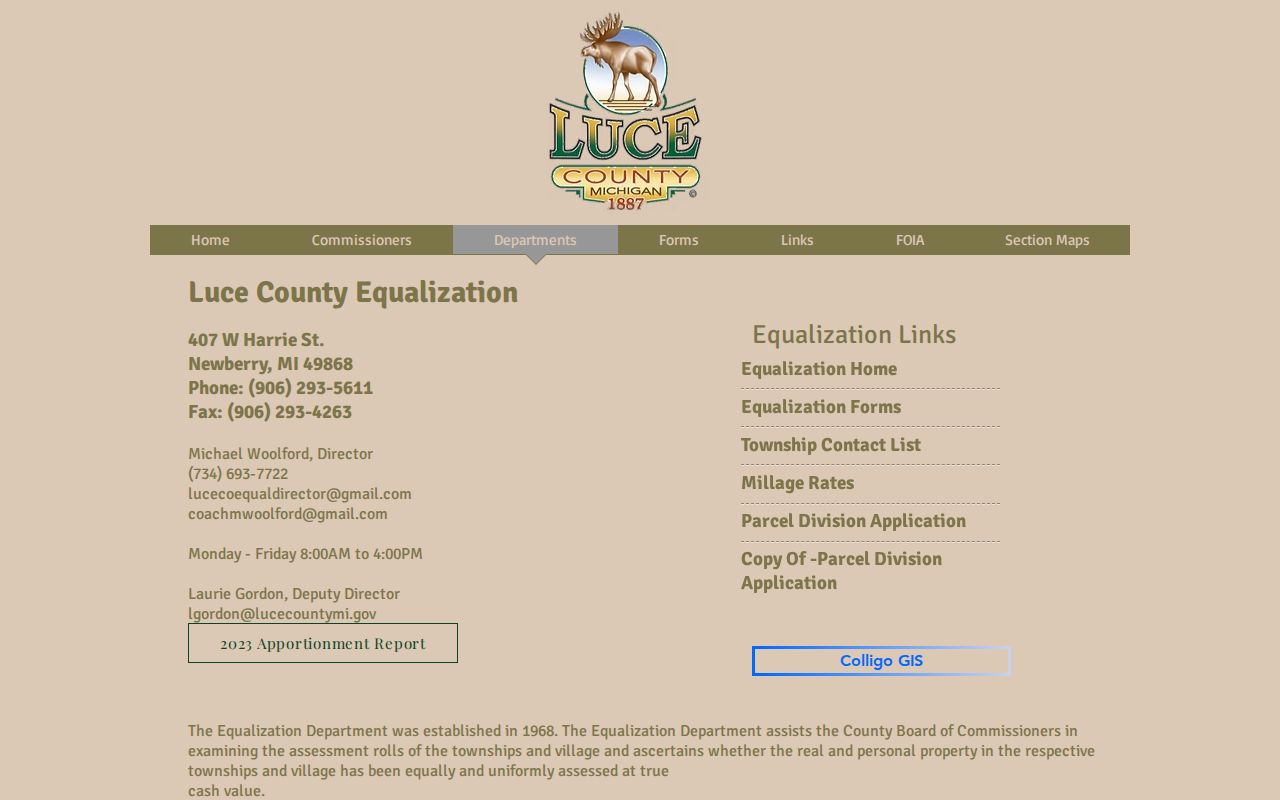
The image shows the office gateway itself, not a live value-detail card. When Colligo does not expose year or roll labels, ask the local assessor for the exact figures.
Separate Luce Assessed and Taxable Values
Two numbers drive a Luce County tax bill. State Equalized Value mirrors the equalized assessment. Taxable value is the figure millage actually multiplies. Michigan's annual cap can hold it below assessed value for years. A transfer of ownership then triggers uncapping under state law.
That is why two nearly identical parcels can carry the same assessed value. But their taxable values can differ greatly. The Michigan Tax Tribunal glossary separates assessed value, SEV, capped value, taxable value, and transfer uncapping. Match the year, and study the ownership-transfer history, before treating any comparison as sound.
Use Luce Sale Price as One Market Clue
A sale price is a clue, not a verdict. The Property Transfer Affidavit, Form 2766, records the transfer date, price, parcel number, buyer, seller, and classification. It carries a 45-day filing deadline. A deed paired with that affidavit establishes the reported consideration for one transaction on one date. Neither document proves value on any other date.
MCL 211.27 bars assessors from automatically equating true cash value with purchase price. Family transfers, partial interests, distress sales, bundled land, or unusual financing can all distort a comparison. Check the legal description before relying on the number. The rights sold must match the subject parcel too.
Request Luce Land and Improvement Components
A solid assessment request is specific. Ask for the parcel number, the year, the property class, and the split between land value and improvement value. Add total assessed value or SEV, taxable value, PRE or agricultural status, and the last-transfer field where public. Field labels on the county's online cards may differ. Request the data itself rather than a particular screen.
| Field to request | Reason to compare it |
|---|---|
| Tax year and parcel ID | Prevents mixing years or parcel splits |
| Land and improvement values | Separates site and structure contributions |
| Class and PRE | Explains treatment without proving occupancy |
| Last transfer | Creates a deed and affidavit cross-check |
PRE and Agricultural Status Affect Luce Records
Exemption status changes how a Luce County parcel is taxed. The county forms page links Principal Residence Exemption, transfer-affidavit, parcel-division, and addressing materials. Michigan's exemption directory covers agricultural, disabled-veteran, poverty, and other programs.
PRE Form 2368 asks for the parcel ID, owner, occupancy, prior exemptions, and assessor action. The outcome shapes the tax bill. It is not a market-value estimate, nor conclusive proof that anyone currently lives there.
Compare Newberry Neighborhood Context Carefully
Newberry planning material describes older homes, alleys, small lots, public facilities, and some multi-family development across the Northwest, Northeast, and Southwest areas. Those details can shape comparable-parcel questions. A neighborhood label cannot set value by itself.
Newberry sits within McMillan Township, while rural Luce County holds forest, lakes, river corridors, seasonal roads, and extensive public land. Match jurisdiction carefully. Good Luce County comparables also share access, acreage, improvements, waterfront influence, and rights, not merely a postal city.
Assemble Evidence for a Luce Value Review
A strong Luce County value review ties every comparison to one valuation date and a genuinely similar parcel. Start with the assessment notice. Ask the assessor for the property characteristics, land and improvement components, classification, taxable value, and any sales used in the analysis if public. Fix factual errors first. Acreage, building size, condition, outbuildings, access, waterfront influence, and parcel combination or division can all change the comparison.
Recorded transfers come next. The Luce County Register of Deeds holds them. That office publishes no public deed-index search, so frame any request with party-name variants, an approximate year, the parcel or legal description, instrument type, and any known book, page, or document reference. Fees are modest but add up. A real-estate name search runs $0.50 per name per year with a $5 minimum, plain copies cost $1 per page, and certification adds $5 per document. Confirm scope and current charges before ordering.
Screen each sale for true comparability. Compare property rights, location, local unit, lot size, improvements, condition, sale date, and circumstances. A quitclaim deed can report a transfer without an open-market sale. Estate and family conveyances may not reflect ordinary exposure either. Avoid taxable value as a sale-price proxy. Capping can preserve big differences between parcels that are otherwise quite similar.
A Board of Review petition needs the parcel number, disputed values, requested values, property class, grounds, photographs, corrected measurements, and a concise table of comparable sales. Form L-4035 captures those core fields. Keep your proof. Hold onto the local filing instructions as well, because meeting dates and protest methods follow each local unit's own calendar.
Use like with like. A nearby mailing address is not automatically a comparable; match legal rights, physical characteristics, jurisdiction, date, and transaction conditions.
Historic Luce Rolls Add Context, Not Current Value
Luce County's past sits in paper, and some of it still matters. The Archives of Michigan holds Luce County assessment rolls covering 1887 through 1923. Those rolls can name an earlier taxpayer, a land description, a property class, or an assessed amount. They also help trace one parcel across changing addresses over decades. The Library of Michigan points to more. It lists plat books plus Newberry News microfilm running from June 1886 through 2014. Sale notices, improvements, businesses, fires, estates, and road references all surface there.
Treat these as history, not valuation. Assessment standards, currency, parcel boundaries, and local conditions have all shifted since then. A figure from a 1900 roll cannot stand on its own. It cannot sit beside a current Luce County property value estimate. The rolls work best for rebuilding a dated record trail. For present valuation, return to the current assessor, deed records, and recent verified sales.
Estimate Luce County Property Value from Records
Use a repeatable sequence so each figure retains its date and source.
- Locate the parcel through Colligo and verify situs and legal description.
- Obtain the local assessment record and capture assessed, SEV, and taxable values by year.
- Check the latest deed and transfer affidavit for date, rights conveyed, and consideration.
- Compare genuinely similar sales or obtain an independent appraisal for a current opinion.
- Assessed value
- The locally determined value generally set at half of true cash value.
- Market value
- An estimate of exchange value for specified rights, conditions, and date.
- Level of assessment
- The ratio of assessed to true cash value; Michigan's standard is 50 percent.
Limits of Luce County Property Value Records
Assessment is mass appraisal for fair taxation. It is not a title search or a boundary survey. It is not a structural inspection or a promise of sale proceeds. Colligo may locate the parcel. A map's geometry cannot price condition, access, improvements, or the full bundle of rights.
Challenging an assessment starts small. Begin with the notice and your local assessor. Michigan's Board of Review instructions and Form L-4035 call for the parcel number, class, assessed and taxable values. They also require the requested amount and your protest grounds. Confirm the local calendar right away, since deadlines vary by Luce County unit.
Documentation wins protests. Keep dated copies of the assessment card, notice, deed, and transfer affidavit. Add photographs, measurements, and a comparable-sale table. Label each comparison by location. Note whether it is inside Newberry, elsewhere in McMillan Township, or another Luce local unit. Road access, waterfront influence, acreage, structures, public-land adjacency, and transaction conditions explain apparent gaps. They explain far better than price per acre alone. Was the parcel divided or combined? Reconcile the old and new identifiers before comparing values across years.
Value is not price. A Luce County assessment does not predict a sale price; obtain a licensed appraisal when a defensible current market opinion is required.