
Luce County Former Owners Across Time
Work backward. Start at the newest reliable transfer. Then step toward older records one deed at a time. Luce County's Register of Deeds publishes no online index start year, imaging cutoff, or earliest deed book. So no one can promise how far back a browser search reaches. For deeper history, the courthouse vault and the Archives of Michigan remain the dependable channels. Those are the best routes for finding prior owners of Luce County property.
| Transfer Date | Grantor to Grantee | Deed Type | Book/Page |
|---|---|---|---|
| Newest recorded date | Prior owner to current grantee | Copy exact type | Copy office reference |
| Earlier acquisition date | Earlier owner to the newest grantor | Copy exact type | Copy office reference |
| Next linked date | Repeat one transfer farther back | Copy exact type | Copy office reference |
| Physical-book era | Continue with the same legal description | Do not infer | Ask the vault clerk |
Deeds give the true transfer sequence. Rolls and newspapers only suggest a person, year, or place when that sequence stalls. An assessment name marks someone on that year's tax roll, nothing more. Only a recorded conveyance proves the transfer.
Luce County Prior Owners Go Offline
The Luce Register of Deeds charges $0.50 per name per year for real-estate searches. There is a $5 minimum. The office posts no public deed-index search link. Request a grantor and grantee index search by appointment. Bring name variants, a narrow date range, the local unit, the parcel number, and the legal description. Vault hours run weekdays from 8:00 a.m. to 3:30 p.m., by appointment only. Luce County deeds live on paper. Plan the visit around what the staff can pull.
Unpublished digital reach. Luce County has not published an online index cutoff; older owners may require the courthouse vault, physical volumes, or archives.
The screenshot below comes from the official office page.
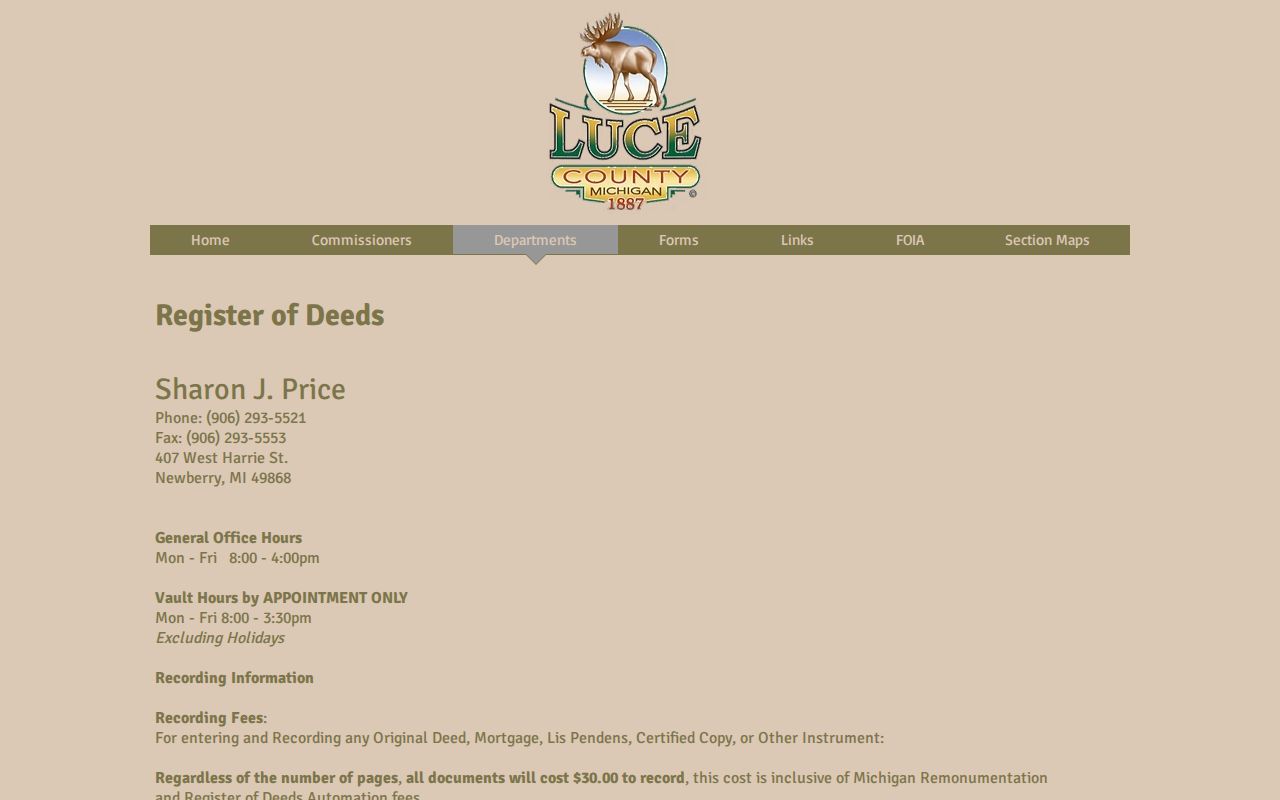
The office page documents its access rules and fees plainly. A former-owner search in Luce County therefore cannot lean on a web index alone.
Reconstruct Luce County Owners Backward
Begin with the current deed. Do not start from the oldest surname in a newspaper clipping. The grantor is whoever transferred an interest in the land. The grantee is whoever received it. Chain of title is the linked run of deeds covering the same parcel, and a reverse index walks a named party backward toward that party's own acquisition. The legal description stays the stable check throughout.
- Identify the present parcel and obtain the latest recorded deed.
- Copy its grantor, grantee, date, deed type, book and page or instrument number, and legal description.
- Search the grantor as an earlier grantee, testing initials, maiden names, and entity variations.
- Repeat until the local index ends, then ask for the next physical book, reel, or archive series.
- Grantor and grantee
- The transferring and receiving parties named in a deed.
- Chain of title
- The ordered link between past recorded conveyances.
- Reverse index
- A party-name index used to work from a transferor toward an earlier acquisition.
- Warranty and quitclaim
- A warranty deed states title promises; a quitclaim transfers only the interest the grantor may have.
Keep Luce County Owner Parcels Fixed
Names repeat constantly. Land descriptions do not. A Newberry lot may be identified by subdivision, lot, and block, while rural Luce County land may rely on township, range, section, or metes and bounds. Metes and bounds uses bearings and distances from a point of beginning, sometimes naming an adjoining owner of record. A parcel split or combination can create a new tax number even when an older deed still describes the parent tract.
Copy every description exactly. Compare it against the Michigan Online Land Survey Records search and any recorded plat the deed cites. That search covers record type, number, project, and date. For government-survey land, the Archives guide places Luce County in ranges 8W through 12W and townships 45N through 50N. Those coordinates beat a postal city label every time.
Test Luce County Prior Owners
A transfer affidavit can date a change. Michigan Form 2766 records the transfer date, price, parcel identifier, buyer, and seller. Take the parcel number from the tax bill or assessment notice. Then test the names against the recorded deed. The affidavit is only a cross-check. It never replaces the conveyance itself.
Estates can interrupt a tidy buyer-to-seller line. Search probate files for a will, personal representative, or court authority. Then return to the deed office for the recorded transfer. Trusts add trustee deeds and trust certificates, so keep fiduciary capacity attached to the name. The same person may appear once as an individual and once as a representative.
Historic Luce County Owners Beyond Deeds
The Archives of Michigan holds a rare three-part paper trail for Luce County. Its collection includes assessment rolls from 1887 through 1923. Lis pendens notices run from 1889 through 1943, and lien discharges from 1890 through 1956. Lis pendens simply means notice of pending litigation affecting land. A name found in one series can lead to a dispute or release. That may explain why a clean deed sequence seems to skip a transfer.
Archives staff recommend the catalog and county guide. Come with the legal description, date, and agency named, and request material one to two weeks ahead. The reading room sits in Lansing. The Luce County guide was revised in 2023. Historic land-ownership plats add further checks for prior owners. So do a 1917 plat book, a tax-redemption register running 1890 through 1917, and lien claims.
Newberry News Names Former Owners
The Library of Michigan holds Newberry News on microfilm from June 1886 through 2014. That span covers nearly the county's whole organized era. A notice can date a sale, estate, business, road name, fire, or legal dispute. Such details can come to light before any parcel card exists. Search maiden names, initials, widow labels, and nearby place names. Newberry, McMillan, Curtis, Engadine, and Lakefield each may yield a different clue. Any of them may point to a former owner of record.
The Luce County Historical Museum and Historical Society hold obituary files, scrapbooks, centennial books, and local histories. The collection also includes a 1920 Newberry High School yearbook. These sources can identify likely former owners and place them in an era. They cannot establish title. Carry each clue back to a deed or an assessment roll.
When Luce County Owners Cross Borders
Luce County was organized in 1887 from land that belonged to Chippewa and Mackinac Counties, so a deed trail can predate the county itself. Older instruments may sit in a parent county's deed records. Newberry sits inside McMillan Township. Columbus, Lakefield, McMillan, and Pentland make up the rest. A Newberry mailing address can therefore coexist with township assessment lines and county recording references, so keep every layer in mind when you trace a parcel.
ZIP labels are not legal boundaries. Newberry 49868, McMillan 49853, and Curtis 49820 are postal clues, but USPS city lines may not match parcel lines. Preserve both the situs and the mailing address. Situs is where the land lies. The mailing address is where notices go. Neither a tax-roll name nor a mailing address proves that someone actually lived on the parcel.
Audit a Luce County Owner Timeline
Build a working table before trusting any index sequence. Each row should carry the transfer date, recording date, grantor, grantee, exact deed type, book and page or instrument number, parcel key, and legal description. Add a separate source column too. An assessment roll, plat, newspaper, probate file, or lien record can anchor each entry. That format makes a gap visible fast. It also keeps a same-name person from sliding into the wrong chain.
Dates need care. Execution, recording, assessment, and publication can each land at a different time. A tax affidavit may state a transfer date and price, while the deed supplies the actual conveyance language. An assessment roll names the person attached to that tax year. Probate papers may show authority before a fiduciary deed is recorded. Preserve each date with its source. Never force them into one event.
Finish the audit by reading the legal description in every linked deed. Note acreage changes, lot or block shifts, section calls, and parent-tract language. If the land description changes without an explained split, plat, or consolidation, stop the chain there and ask the Register of Deeds for the missing reference. A plausible surname sequence is not enough.
Limits of Luce County Former Owners
No courthouse fire or wholesale records loss marks the county's deed history, and no exact earliest deed volume is published. Do not invent a gap explanation. Ask the Register of Deeds where its first local grantor-grantee volume begins. Also ask whether pre-1887 instruments lead back to Chippewa or Mackinac County. General Land Office plats show federal survey-era geometry. They are not current title maps.
Former-owner work is strongest when each row holds a transfer date, grantor and grantee, deed type, recording reference, and legal description. Mark every assumption plainly. An archive clue is not a recorded transfer. For the mechanics and price of ordering one instrument, use the Luce County deed records details.
Lawful use. Research past owners for land history, estate work, or purchase diligence, never to track or harass a living person.