
Search Newberry Records by Address
Start with the county-linked Colligo map or Luce Equalization. Jot down what the source actually shows: the situs address, owner label, mailing address, parcel number, local unit, and legal description. Field labels and layer controls vary by viewer. If the map never opens a usable parcel card, call Equalization or the local assessor instead.
- Normalize the Newberry street, direction, suffix, and unit.
- Match it to the county parcel and legal description.
- Request the needed tax years from the Treasurer.
- Search party names with the Register of Deeds.
- Request Village zoning, site-plan, and permit records.
From there, chase the record by question. The Treasurer holds tax history. The Register of Deeds searches recorded instruments, and the Village holds planning files. The full Luce County property search workflow explains the county mechanics.
Newberry Records Cross Two Desks
Two desks split the work. County custodians keep the deed records, assessments, taxes, and parcel sources. Village staff keep the land-use records. Newberry has no separate recorder or city assessor of its own. Once the parcel is pinned down, take the county route, then add the municipal file when zoning, site-plan review, a special use, or a local approval enters the picture.
Luce County Custodians
Equalization, the Treasurer, and Register of Deeds hold the county trail.
Newberry Permits and Zoning
307 E McMillan Street
Newberry, MI 49868
906-293-3433
Newberry Sits Inside McMillan
Newberry is the county's only incorporated community, and it sits inside McMillan Township. The village dates its incorporation to 1885. That was two years before Luce County itself was organized. This history is layered. One street address can carry a village zoning record, township assessment context, county deed and tax records, and state building review all at once.
The county publishes no annexation history or parcel-prefix guide. Never guess from the postal city. Instead, compare the village boundary. Compare the local unit on the tax roll, the parcel number, and the legal description. County rural zoning treats the incorporated village separately too. A neighboring Newberry mailing address may fall under a different ordinance.
ZIP 49868 Is Not a Boundary
The Newberry post office and ZIP 49868 describe mail service. They do not describe a legal village outline. A Newberry mailing label can serve land well outside the compact incorporated area. McMillan carries ZIP 49853, and Curtis uses 49820 as another regional clue. Still, ZIP lines and Census statistical shapes never settle parcel jurisdiction.
For a specific property, validate the postal address first. Then check the county parcel map and legal description. Keep the situs address and the tax mailing address separate in your notes. A post-office line can locate an owner or route mail while the land itself sits in another assessment or zoning unit.
Newberry Site Plans Leave Clues
The Village site-plan rules point to a rich property file. A submitted plan may list the owner or applicant and a boundary survey. It may also cover acreage, the legal description, and zoning on adjacent land. Structures, rights-of-way, access, parking, drainage, landscaping, and utilities can appear too. Those details can date a proposed change and tie it to a parcel.
Ecode360 publishes the rule itself, not a searchable permit-history database. Ask the Village or Planning Commission for the application, plan, and minutes. You can also request the staff decision, conditions, and final status. New-building plan review may also involve the Michigan Bureau of Construction Codes. Keep zoning approval, building review, and final inspection as separate records.
The ordinance page names its source. It spells out exactly which property details a site plan must include.
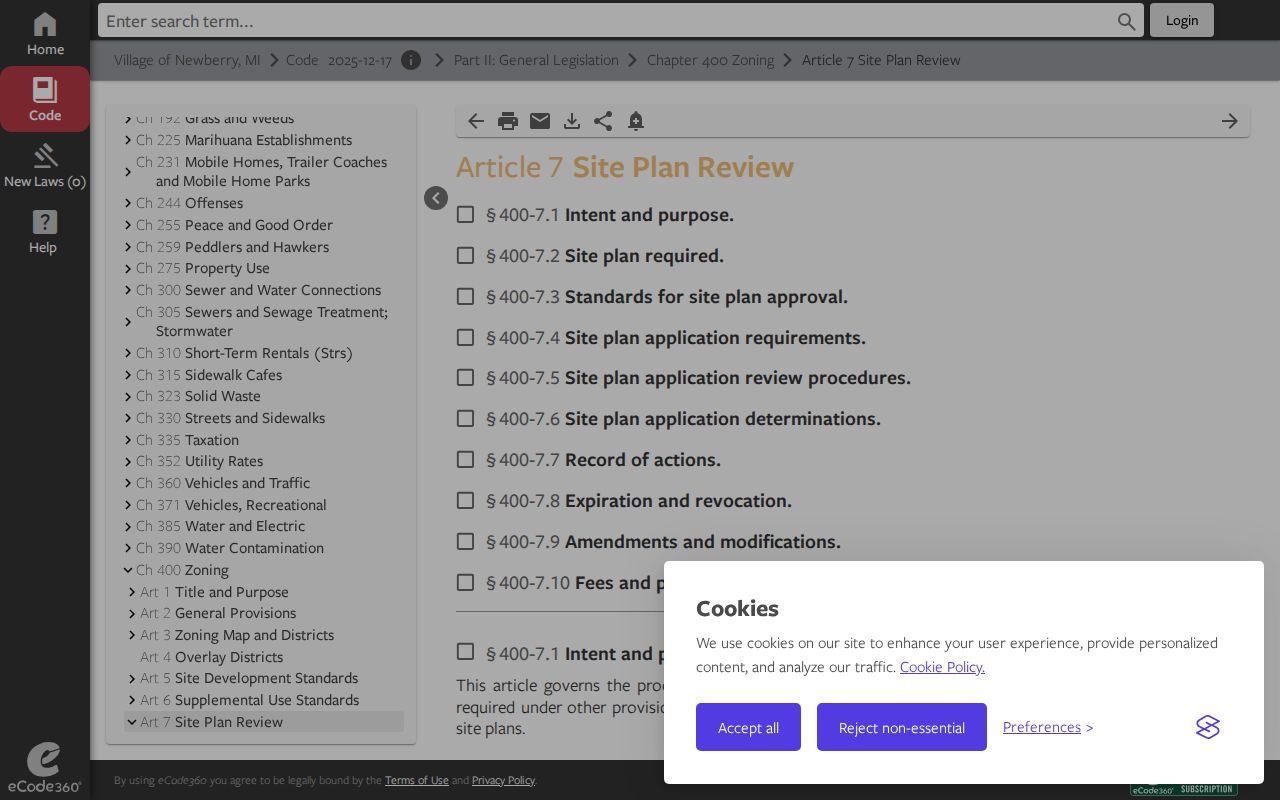
Its legal-description requirements help most when an address alone cannot settle the site. Adjacent-zoning details matter there too. Save the ordinance section number and version date with your request. Proposed, approved, and final-inspection records are distinct things. Match each one to the parcel and its final action.
Newberry Neighborhood Record Clues
The adopted master plan names five planning neighborhoods. They work well as map and address anchors. They are not recorded subdivision names. A deed or plat question still needs a legal description, an OLSR search, and a Register of Deeds record.
| Neighborhood / Subdivision | Era | In the Records |
|---|---|---|
| Northwest | Older homes, mixed lots | Plan area bounded by McMillan, railroad, village line, Newberry Avenue |
| Northeast | Older small-lot grid | Plan area near Sherman Park and Tahqua-Land Theater |
| Southwest | Older homes, multifamily pocket | Planning context for site-plan questions |
| South Central and Southeast | Plan-defined areas | Use plan map for edges, then verify any recorded plat |
Northwest and Northeast follow strong edges: McMillan Avenue, the railroad, Newberry Avenue, and the village boundary. Named roads and landmarks can narrow an old newspaper reference quickly. Only the parcel and legal description connect that clue to the Luce County parcel map and the recorded land files.
Verify Newberry Plats Through OLSR
Michigan's OLSR system is the state route for subdivision and survey records. Search by record type, record number, project name, optional criteria, and date. Open the result details and attachments. Then compare the project name and legal description against the tax parcel. A planning-neighborhood label should never be typed in as a recorded plat. The instrument itself must confirm it.
The Village site-condominium rule creates a direct link to county land records. It requires Planning Commission and Council approval. A master deed and bylaws, agency review, and an as-built copy recorded with the Luce Register of Deeds complete the process. That final recorded reference beats any proposal drawing when you trace a condominium parcel.
Newberry News Dates House History
The Library of Michigan keeps Newberry News microfilm from June 1886 through 2014, along with Newberry Enterprise issues from part of 1894. Compiled death notices run from 1951 through 2000. A single issue can carry an estate notice, a widow's name, a business reference, or a street clue sitting right beside a recorded transfer.
Local historical holdings add more leads. Obituary files, scrapbooks, centennial books, cemetery information, and a 1920 Newberry High School yearbook all sit in the collection. None of it proves ownership. Treat each item as a lead, record the publication, date, page or reel, and exact wording, then match the person and place against assessment, probate, and deed records for Luce County.
Read Newberry Values Carefully
Newberry has no official neighborhood sale series and no parcel-level value trend. Michigan assessment law offers the safer comparison. Assessed and state equalized values relate to 50 percent of true cash value. Taxable value follows its own cap and transfer rules. A rising taxable value does not mean the market price rose.
The master plan describes older street grids and mixed lot sizes. It also notes a multifamily pocket, parks, rail context, and public institutions. Those qualitative planning facts can explain why nearby parcels differ. For a numeric history, line up one parcel's yearly roll values against recorded transfer dates. Keep assessed value, taxable value, and sale price in separate columns.
Limits of Newberry Property Records
Newberry property records can show the assessment owner of record, value fields, taxes, recorded transfers, liens, plat references, zoning rules, and planning decisions. They cannot prove beneficial ownership, occupancy, exact surveyed boundaries, code compliance, or present market price. The assessment roll may lag a recent deed. A trust or company may also appear where an individual once did.
Lawful use. Use Newberry records for property diligence, boundaries, tax review, history, and civic work. A record search is not a title search, and owner data must never be used to harass anyone.
Request Unindexed Newberry Files
Newberry publishes no searchable permit-history, city-directory, cemetery-interment, municipal-court, or business-license index. That gap is about access, not existence. Route the question to the right office. Try the Village Clerk, the zoning administrator, the Planning Commission, the county Building Department, or a local historical group. Village government contacts come first for current municipal files. The Luce County Historical Museum and Society can help identify older material, but it publishes no hours or reproduction fees. Call ahead and describe the property question precisely.
A written Michigan FOIA request to the Village should state the address, parcel number, and legal description. Include the record type, date range, meeting or project name, and preferred format. Ask for a fee estimate. Deeds, taxes, assessments, and court papers belong with the county custodian's normal procedure instead. A reliable Newberry property records file labels every source and keeps planning evidence apart from recorded title documents.
Site-plan requests have their own checklist. Ask for the application, the applicant or owner name as filed, the boundary survey, legal description, adjacent zoning, staff report, minutes, conditions, and final action. For building work, keep the village zoning permit separate from state plan review and inspection records. A site condominium calls for the master deed and the as-built recording reference. Where no searchable index exists, give staff a narrow year range and a project or address so the search stays manageable.
Historic requests turn on different keys. Offer the Newberry neighborhood or landmark only as orientation. Then add exact street wording, surname variants, a date span, and any township, range, section, lot, or block reference. A newspaper notice can narrow the period. An old assessment roll can place a name on land. A probate order can explain authority. The recorded deed completes the transfer trail. Label each source by what it proves. Note: keep a log of the office, search terms, years checked, and staff response. An unanswered gap is never mistaken for proof that no record exists.