
Start a Luce County Search
Treat a Luce County property records search as a chain of steps. Start with the county-linked Colligo parcel map and search by street or road location. Then copy everything the live parcel card offers. Take the parcel or index number, situs address, mailing address, owner label, and legal description. The map's public controls may change. Treat it as a gateway, not a promise of owner-name lookup or export tools. If the project will not load, Equalization or the local assessor is the fallback.
Next, split the work. Give the Treasurer the parcel key. Give the Register of Deeds the party names and legal description. A map polygon locates tax land. It does not prove a surveyed boundary. An assessment owner is just the name on a roll, not a title opinion. Each source answers one part of the question. A recent transfer can show up in a recorded deed before the annual tax roll catches up.
- Normalize the address, including road direction, suffix, route number, and township.
- Open Colligo or ask Equalization for the parcel number and legal description.
- Request the tax history from the Luce County Treasurer by parcel and tax year.
- Ask the Register of Deeds to search grantor and grantee names across a stated date range.
- Order the right recorded instrument or court order only after its reference is confirmed.
Where Luce Property Records Live
Three courthouse offices hold the core Luce County property records. None of them merges into a single search. The Register of Deeds keeps recorded deeds, mortgages, releases, liens, easements, and plats. Equalization builds the assessment framework and links the public parcel map. Township and village assessors maintain the local rolls. The Treasurer rounds things out with permanent and delinquent tax histories. It also tracks redemption status and tax certification. All three offices sit in the County Government Building in Newberry.
Luce County Register of Deeds
407 W Harrie Street
Newberry, MI 49868
906-293-5521
Luce County Equalization
407 W Harrie Street
Newberry, MI 49868
906-293-5611
Luce Deed Access Stops Online
The Register of Deeds page posts a detailed fee schedule. It offers no public deed-index form, coverage year, or imaging cutoff. That gap shapes how you search. A request should name every grantor and grantee variation. Include the approximate years, the township or local unit, the parcel number, the legal description, and the instrument type. Ask the office directly whether it can search by parcel, address, or instrument number. Party-name searches may be the only option. A failed web search is not proof that no deed exists.
Real-estate searches cost $0.50 per name per year, with a $5 minimum. Plain copies run $1 per page, plats cost $2, and certification adds $5 per document. The deed vault is open by appointment on weekdays from 8:00 a.m. to 3:30 p.m. Phone, mail, or fax can help. But the office does not promise that every search can be finished through those channels. Confirm the method and the total before sending payment.
Recorded papers go well beyond warranty deeds. Mortgages, land contracts, assignments, discharges, covenants, lis pendens, easements, fixture filings, and tax liens can all shape the land trail. Search the releases as carefully as the original claims.
Reading the Luce Parcel Gateway
Both the county home page and the Equalization office link to a public Colligo GIS gateway. The live Luce project runs on JavaScript. The county connection is real. Search labels, layer lists, print tools, owner fields, and refresh dates may all vary. Copy only what the current card actually displays. If the map gives no usable result, contact Equalization or the local assessor and request a public parcel card.
| Search clue | Best use | Limit |
|---|---|---|
| Situs address | Locate the land and map point | Rural road formats and changed numbers can fail |
| Owner name | Group parcels carried under one roll name | Trusts, estates, initials, and roll lag can hide a match |
| Parcel number | Join map, assessment, tax, and transfer records | Luce has not published a format guide |
| Legal description | Bridge deeds, plats, and older books | Lot-and-block or survey terms may need staff help |
A mailing address only tells offices where to send notices. It is not the land's location, and it proves nothing about who lives there, so keep it distinct from the situs address while you search.
Newberry Changes the Jurisdiction
Newberry is the only incorporated community in Luce County. It sits inside McMillan Township. The other four local units are townships rather than cities. That matters. One Newberry property file can pull together village zoning, township assessment and tax records, Luce County deeds, and state building review all at once. A ZIP like 49868 is just a delivery clue. It draws no legal boundary. Countywide property records still anchor the search. Village planning papers can add detail, though, including site plans, special-land-use decisions, and site-condominium filings. Newberry's ordinance requires a legal description and can call for surveys, adjacent zoning, rights-of-way, drainage, utilities, and proposed improvements. The Newberry property records route covers that city lens without treating the village as its own records custodian.
Jurisdiction key. Match the village boundary, local assessment unit, parcel number, and legal description before deciding which office should answer.
Luce Property Record Types
A single parcel can show up across several Luce County property records. Each custodian logs a different event. Deeds record conveyances. Assessment rolls carry class and value, tax histories track billing and delinquency, and GIS maps with plats locate the land itself. Planning files document proposed or approved work. When a judgment, foreclosure, estate, or quiet-title case reshapes ownership, court and probate records enter the picture too.
| Record Type | What It Documents | Kept By | Access |
|---|---|---|---|
| Deeds and land contracts | Transfers, parties, legal descriptions | Register of Deeds | Office search and copy request |
| Mortgages and liens | Recorded claims and later releases | Register of Deeds | Name/year search; copy fees apply |
| Assessment and tax | Class, values, exemptions, payments, delinquency | Local assessor, Equalization, Treasurer | Map or direct office request |
| Plats and parcels | Tax-map location, lot/block, survey references | Colligo, ROD, state OLSR | Public gateway and recorded copies |
| Planning and permits | Site plans, zoning review, inspections | Village, county, Michigan BCC | Ordinance pages and record request |
Match the record to the question. A deed answers transfer and encumbrance questions. The assessment roll plus tax history handles current assessment administration. For location, the GIS polygon is only a locator. The recorded plat or deed holds the legal language. A court docket may flag a dispute. Request the actual judgment and its recording reference before counting it as a land event.
Luce Values Use Michigan Rules
Luce Equalization aims every assessment at one target. That target is the state standard of 50 percent of true cash value. Assessed value, state equalized value, and taxable value are cousins, not twins. Michigan caps taxable value until a transfer uncaps it. And a last sale price can reflect a family deal, an auction, or an estate settlement. It may not show an open-market trade. The official Luce County Equalization page links to assessment forms and parcel resources.
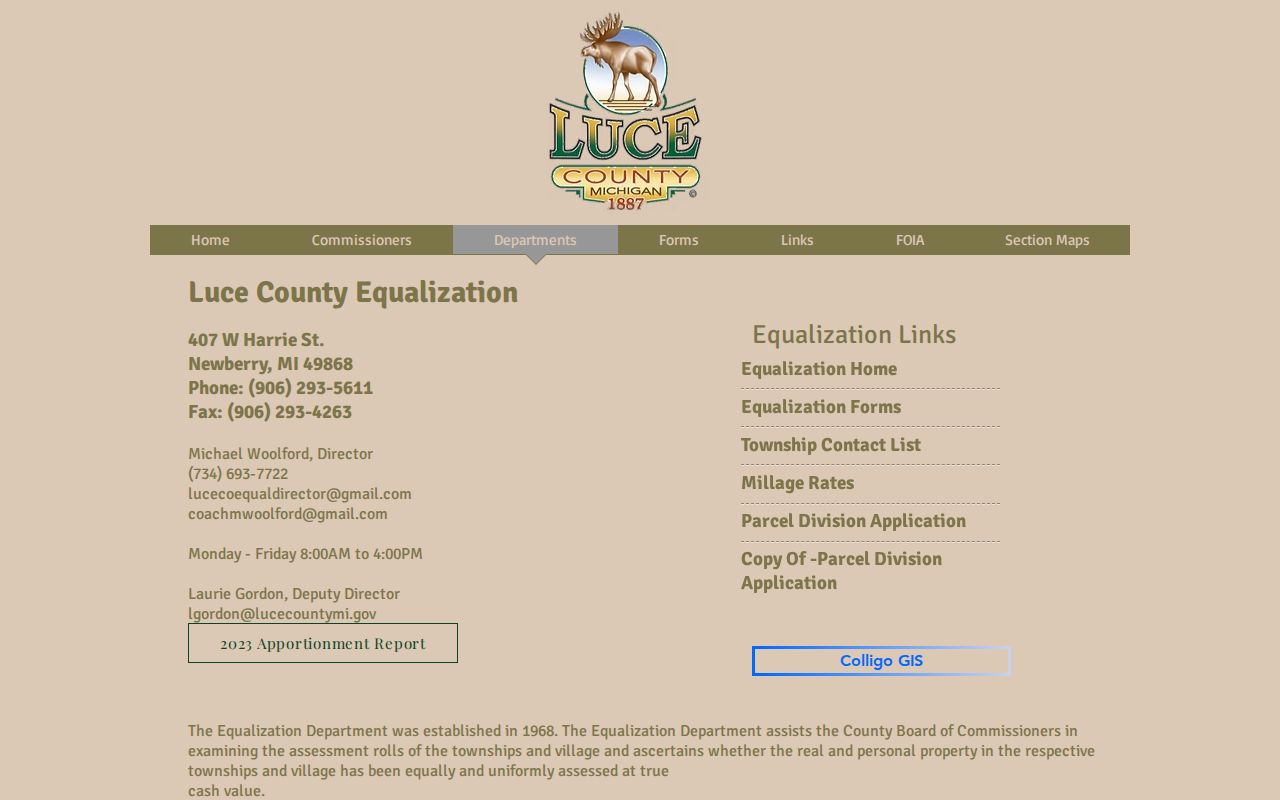
The county gateway confirms the Equalization office's role, but the county publishes no live parcel-card field set online. Ask the local assessor for the current roll whenever an owner of record or value must be exact.
- Assessed value
- The local assessment figure before equalization.
- State equalized value
- The value after county and state equalization, generally tied to half of true cash value.
- Taxable value
- The capped base used in the tax calculation, subject to Michigan transfer rules.
- Parcel
- A mapped tax unit identified by a local number and legal description.
Luce Tax Records Need a Request
Luce County publishes no online tax-bill lookup. The Treasurer handles permanent rolls, delinquent rolls, tax histories, redemption details, and tax certification. The cost is nominal. Give the parcel number, local unit, legal description, and exact tax years. Ask about charges before ordering a long history.
Delinquency starts a process, not an instant loss of the property. Luce's published warning is blunt. Payment must arrive before month-end, and a postmark does not count. Partial payments may be accepted while interest and fees keep running. A delinquent list alone never settles foreclosure. Payment, redemption, bankruptcy, court action, or correction can change the status.
Note: Ask how the Treasurer timestamps receipt before mailing a payment near a deadline.
Historic Luce Property Rolls
When current systems run dry, Luce County keeps an unusually strong paper trail. The Archives of Michigan county guide lists assessment rolls from 1887 through 1923. It also lists a redemption-certificate register from 1890 through 1917. Notices of lis pendens run from 1889 through 1943. Lien discharges run from 1890 through 1956. A run of that depth can pin an owner to a date range. It can also pin a tax problem, dispute, and release.
Archive work is not an online parcel lookup. Search the catalog first. Then supply the county, township, range, section, legal description, year, agency, and likely record group. Staff suggest requesting material one to two weeks ahead. Luce was organized in 1887 from parts of Chippewa and Mackinac Counties. So an older chain of title may continue through a parent county rather than start with Luce.
- Fix the land in township, range, section, or lot and block.
- Compare the modern legal description with old assessment rolls.
- Check historic plats and the 1917 plat book for map context.
- Match any dispute to lis pendens and court material.
- Return to the deed index for the recorded instrument.
Newberry News Tracks Land Clues
The Library of Michigan holds Newberry News microfilm from June 1886 through 2014. That spans nearly the county's whole organized life. Its catalog also lists the Newberry Enterprise for part of 1894. It adds death-notice compilations covering 1951 through 2000, plus a long series of Luce plat and atlas holdings. A dated notice can surface a surname variant, an estate, a former street label, a business name, or a sale period. Any one of these can sharpen a courthouse request.
Newspaper language stays a clue. It cannot replace a deed, probate order, or certified judgment. Record the publication, date, reel, page, exact spelling, and address wording. Then test each fact against the official land record. The Library of Michigan Luce guide maps the collection.
Luce Court Files Affect Land
Quiet-title suits leave marks on Luce County property records. So do foreclosures, partitions, judgment liens, and probate sales. Start with the statewide MiCOURT party or case-number search. Then request the actual file from the 11th Circuit Court or Probate and Family Court. Online results are informational only, and they can omit attachments, protected papers, or older material.
Record the case number, court, party roles, filing date, and status. Note the disposition, docket events, and any parcel or legal-description reference. Pair the judgment or estate order with the Register of Deeds entry afterward. Michigan FOIA does not govern judicial files. It covers county or village administrative records instead. Court access rules and the clerk control the case file.
Limits of Luce Property Records
Luce County property records can identify the assessed owner, recorded grantee, mailing address, tax status, value fields, map location, and recorded claims. No single field answers every ownership question. A trust or limited liability company may hold title as the named owner. A roll may lag behind a recent sale. A mailing address may sit outside the county. And a GIS map line can differ from a surveyed monument or a deed call.
Lawful use. Luce County records support purchase research, boundary review, tax questions, estates, and civic transparency. They do not replace a title search or licensed survey, and owner information must never be used to harass or target anyone.
Request Missing Luce Records
County, village, and township records can be requested under the Michigan Freedom of Information Act. Name the parcel precisely. The request should carry the address, legal description, local unit, record type, date range, and the format you want. The public body then has five business days to grant, deny, partly grant, or take one extension. Search, review, separation, copy, and mailing fees may apply under the statute.
Use the office's own route when one is clear. The deed vault works one way. The Treasurer's tax-history request works another. Archives advance retrieval and the court clerk differ again. A narrow request costs less and comes back faster than one demanding every record about a person. Keep the response, retrieval date, instrument or case number, page count, and whether the copy is plain or certified.
The closing record trail stays simple. Map the parcel and verify the local unit. Identify the official document. Confirm it with the custodian who holds it.
Bring a compact worksheet to any office search. List the situs and mailing addresses separately. Preserve every hyphen in the parcel number. For deed work, add every name variant, whether individual, spouse, trust, estate, or entity, plus an approximate year range. For tax work, state the local unit and each tax year; for a map or plat, add township, range, section, subdivision, lot, and block when known. Ask the clerk to explain any no-result answer, whether no index match, no image, no record in those years, or a spelling problem.
Record quality still matters after retrieval. Note the source office, access date, instrument or book and page, page count, signing and recording dates, and certification status. A plain copy serves research, while a certified copy carries the custodian's authentication. Compare party names and land descriptions across the deed, assessment roll, tax history, plat, and any court order. Differences should be resolved, not averaged into a guess.